How Often to Replace 16x22x4 Furnace Air Filters
I've spent enough afternoons in Central Florida attics and mechanical closets to know exactly what a neglected air filter looks like before I even pull it out. More often than not, when a homeowner tells me a room feels stuffy or the AC seems to be running longer than it should, the filter turns out to be part of the problem. If your furnace or air handler takes a 16x22x4 filter, here's the real-world replacement schedule I use on my own service calls, along with the signs that tell you it's time before the calendar does. For the broader picture on replacement timing across filter sizes, I've also put together a general guide on how often to change your air filter.
TL;DR Quick Answers
Here's what I tell my own customers: a 16x22x4 furnace filter lasts 3 to 6 months in an average home, closer to 60 to 90 days with pets, allergies, or heavy HVAC use. Check it monthly during peak season, since a higher MERV rating can load up faster in dusty homes.
Top Takeaways
A 16x22x4 filter typically lasts 3 to 6 months under normal household conditions.
Pets, allergy sufferers, and heavy HVAC use shorten that window to 60 to 90 days, and in my experience, that's the group most likely to stretch a filter well past its limit.
A higher MERV rating captures more particles but can also clog faster in a dusty home.
Indoor air can carry pollutant levels 2 to 5 times higher than outdoor air, according to the EPA, so a fresh filter does real work.
A clogged filter forces your HVAC system to work harder, which ENERGY STAR notes shows up as wasted energy and higher bills.
How Often Should You Replace a 16x22x4 Filter?
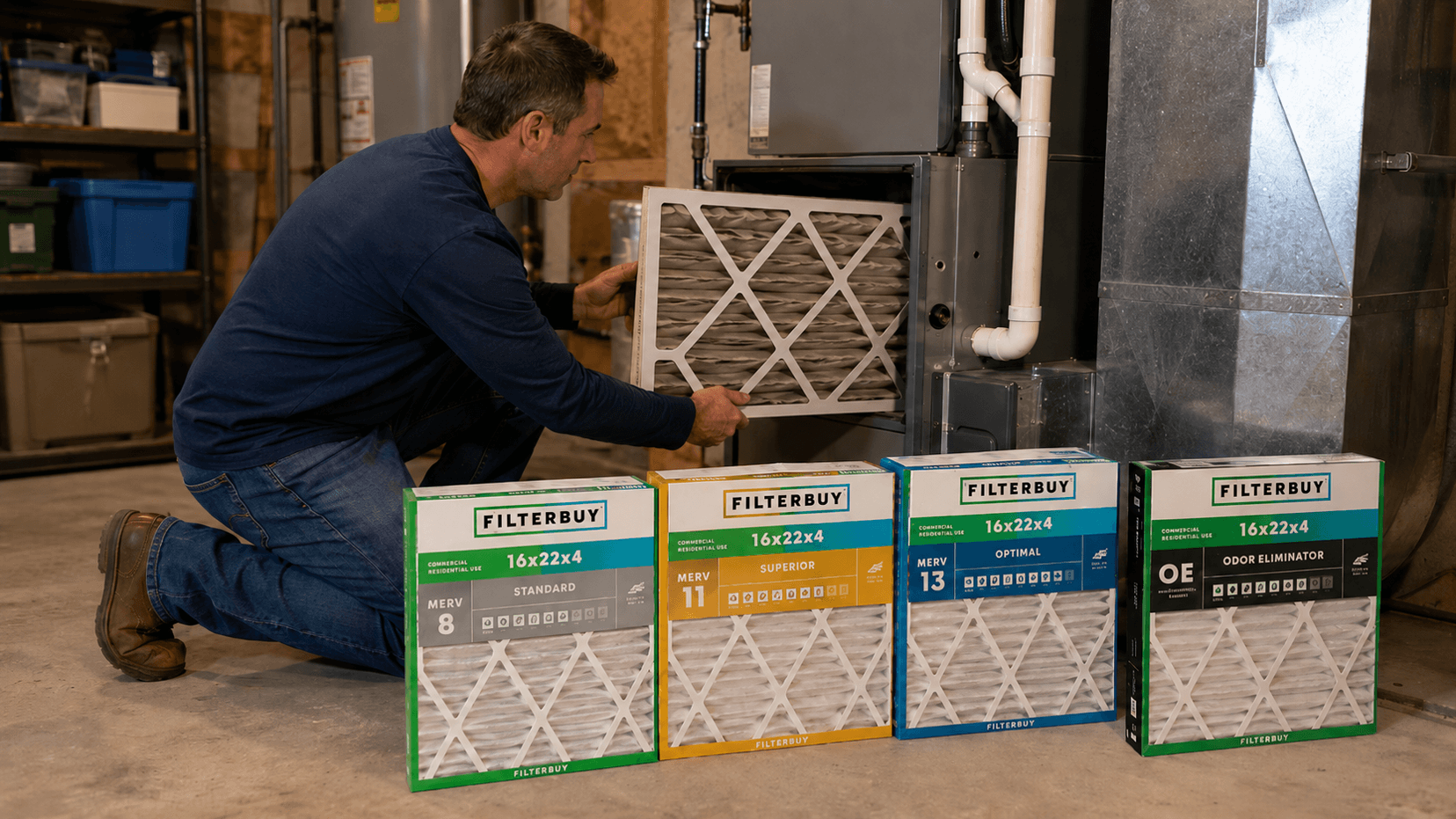
A 4-inch filter like the 16x22x4 has more pleated surface area than a standard 1-inch filter, which is why it generally holds up longer between changes. Under normal conditions, I tell homeowners to plan on replacing it every 3 to 6 months. If you have pets, anyone with allergies in the house, or you run your system heavily through Florida's summer humidity, shorten that to every 60 to 90 days instead.
I see this play out consistently on service calls. A couple in a newer-construction home with no pets can often get close to the full 6 months out of a 16x22x4. The same filter in an older Central Florida home with two dogs and a system that runs constantly is frequently gray and matted by day 50. My own rule of thumb: pull the filter and hold it up to a light. If you can't see daylight through it, it's already past due, regardless of what the calendar says.
Once you know the MERV rating you need, buy directly from a retailer that stocks the exact 16x22x4 dimension in that rating, such as this 16x22x4 replacement air filters selection, rather than settling for a close-enough size that won't seal properly in the frame.
Signs Your Filter Needs Changing Now
These are the same signs I check for on every inspection, roughly in the order I actually look for them:
Noticeably weaker airflow from your vents.
The filter media looks gray or black instead of white or off-white.
Your furnace or air handler runs longer cycles than it used to.
Dust seems to settle faster around the house than normal.
Allergy or asthma symptoms flare up more indoors than outdoors.
Does a Higher MERV Rating Change the Schedule?
Higher MERV filters trap more of the fine particles that trigger allergies, but the denser pleated media also loads up faster in a dusty or pet-heavy home. Extension researchers at Iowa State University note that a general rule of thumb is to change filters at least every three months, with monthly checks recommended regardless of rating. One thing I'll add from my own calls: the higher the MERV number, the more often that monthly check actually matters, because a loaded high-MERV filter restricts airflow more noticeably than a loaded low-MERV one.
On older systems I service, especially units installed before roughly 2015, jumping straight to MERV 13 without checking static pressure is the single most common mistake I run into. I've seen that jump turn a quiet system noisy and put unnecessary strain on the blower motor within a season. If you're not sure your system can handle it, MERV 8 or 11 is the safer starting point until a technician confirms otherwise.
If you're weighing whether to size up, I've written more on this in my breakdown of MERV 13 furnace air filters, including how filter media composition affects both capture rate and airflow resistance.
Nominal Size vs. Actual Size: What You're Really Ordering
One thing that trips people up when they order online for the first time: 16x22x4 is a nominal size, not necessarily the exact dimension of the filter you'll unbox. In the packs I've installed, the length and width usually measure right at 16 by 22 inches, but the frame depth typically comes in a little under the full 4 inches, closer to 3.63 inches, so the filter seats properly without binding in the track. That's normal manufacturing tolerance, not a sign you ordered the wrong size. What actually matters for fit is whether the filter slides into your existing slot without gaps around the edges. If you're measuring for the first time, measure the frame opening itself rather than your old filter's visible media, since a compressed or warped filter can measure smaller than the slot it came from.
Step-by-Step: Replacing a 16x22x4 Filter
This is the same sequence I walk homeowners through on a service call:
Turn off your HVAC system at the thermostat, or at the breaker if you'll have the access panel open for more than a minute.
Locate the filter slot. On most systems, this is at the return air duct or inside the air handler's blower compartment.
Before pulling the old filter, note the airflow direction arrow printed on its frame.
Slide the old filter out and check the frame it came from for gaps, warping, or debris that bypassed the filter entirely.
Insert the new 16x22x4 filter with the arrow pointing toward the furnace or air handler, matching the airflow direction exactly.
Confirm the filter sits flush in the track with no visible gaps along any edge.
Close the access panel and restore power to the system.
Write the install date on the filter frame in marker, or set a phone reminder, so you're working from a real date instead of a guess next time.
If You Replace the Filter and Airflow Still Feels Weak
A fresh filter fixes weak airflow most of the time, but not always. If you've swapped in a new 16x22x4 and vents still feel weak a day or two later, the next thing I check is static pressure, which is really just a measure of how hard your system has to work to push air through the ductwork. High static pressure can come from undersized return ducts, a MERV rating that's too restrictive for your specific system, or leaks in the supply ducts themselves. None of that is something you can diagnose by eye. If airflow doesn't improve within a day of the filter change, it's worth having a technician measure static pressure rather than assuming the fix is an even higher MERV filter.
“In the filter and duct inspections I've done, the single biggest mistake I see is a homeowner stretching a 4-inch filter to nine or twelve months because the intake side still looks clean. Pull it and check the return-air side too. That's usually where the buildup shows up first.” - Bernadette Dento
Essential Resources
These are the sources I actually point customers to when they want to go deeper than what I can cover in one visit:
Confirm the Right MERV Rating Before You Buy
The EPA breaks down what a MERV rating actually measures and recommends MERV 13 or higher when your system can handle it, so you're not guessing at filtration strength when you order your 16x22x4.
Source: EPA
Install It Without Airflow Leaks
The U.S. Department of Energy's filter installation guide covers where the filter box should sit and how to avoid the gaps that let unfiltered air sneak past a poorly seated filter.
Source: U.S. Department of Energy
Build a Replacement Habit That Actually Sticks
ENERGY STAR's heating and cooling guide lays out a simple monthly-check, 3-month-minimum rule, plus what skipping it costs you in wasted energy.
Source: ENERGY STAR
Understand Why Dust Mites Make Filtration Non-Negotiable
The CDC's asthma control page explains how dust mites trigger attacks, which is a useful reminder that a current filter is part of managing indoor triggers, not just an airflow issue.
Source: CDC
See Why a MERV 13 Filter Gets Singled Out
The American Lung Association goes a step further than "change your filter regularly" and recommends a MERV 13 rating specifically for households that want a measurable air quality gain.
Source: American Lung Association
Know Your Odds if Allergies Run in Your House
ACAAI's facts and stats page puts real numbers behind seasonal and year-round allergies, useful context if you're deciding whether to size up your MERV rating for someone in the household.
Source: ACAAI
Compare Filter Costs and Performance Before You Order
California's Air Resources Board fact sheet lays out real price ranges and MERV tradeoffs, helpful if you're weighing a basic filter against a higher-efficiency option for your 16x22x4 slot.
Source: California Air Resources Board
3 Statistics Worth Knowing
Indoor air pollutant levels run 2 to 5 times higher than outdoor levels, according to the EPA. That gap is exactly why a fresh filter matters as much for health as for airflow.
More than 106 million people in the U.S. experience some type of allergy each year, according to AAFA. If anyone in your home falls into that group, lean toward the 60-to-90-day replacement window.
A dirty filter slows airflow and makes your system work harder, which ENERGY STAR flags as wasted energy, recommending a filter check every month and a change at minimum every 3 months.
Final Thoughts and Opinion
A 16x22x4 air filter is an easy thing to forget about because it sits out of sight. In my experience, the households that stay ahead of it are the ones that tie the swap to something else they already do every season, like flipping the clocks or checking smoke detector batteries. It takes less time than most people expect, and it's one of the cheapest things you can do for your HVAC system's lifespan. If I had to pick the single habit that prevents the most emergency calls I get once the Florida heat sets in, it's this one.
Frequently Asked Questions
How do I know if 16x22x4 is the right filter size for my system?
Check the frame around your existing filter or the label inside the door of your air handler or furnace. Most systems list the required dimensions directly on the housing. In the field, I still find it faster to just measure the old filter with a tape measure than to hunt down a manual, since installers occasionally used a slightly different size than what's printed on the unit.
Can I use a lower-cost fiberglass filter instead of a pleated 16x22x4?
You can, but fiberglass filters mainly protect the equipment rather than your air quality. A pleated filter in this size captures far more dust, pollen, and dander.
What happens if I run my HVAC system with a dirty filter for too long?
Airflow drops, your system works harder to hit the same temperature, and you risk dust building up inside the equipment itself, which can shorten its lifespan.
Does a 4-inch filter really last longer than a 1-inch filter?
Generally, yes. The deeper pleats give it more surface area to hold dust before airflow is restricted, which is why 3 to 6 months is realistic for this size versus 1 to 3 months for a thin 1-inch filter.
Should I change my filter more often in Florida's humidity?
I run into this constantly once summer sets in: humidity plus near-constant AC cycling loads a filter faster than the box suggests. If your system runs near-constantly through a humid Central Florida summer, check monthly and don't be surprised if you land on the 60-day side of the range instead of the 90-day side.
Set Your Reminder Today
Put a reminder on your phone today, or write the date on the filter frame as I do on every install. Either method works, but only if you actually use it. The 16x22x4 filters I end up replacing on emergency calls are almost always the ones nobody set a reminder for.
Glossary
A few terms that come up throughout this guide, defined plainly:
MERV (Minimum Efficiency Reporting Value): a 1-16 scale for residential filters that rates how well a filter captures particles of different sizes. Higher numbers mean finer filtration, and also more resistance to airflow.
Static pressure: the resistance your HVAC system's blower has to work against to push air through the filter and ductwork. Too much static pressure strains the blower motor and cuts airflow.
Nominal size: the labeled dimension a filter is sold under, such as 16x22x4. It's a rounded reference size, not necessarily the filter's exact manufactured measurement.
Pleated filter: a filter with folded media that increases surface area compared to a flat fiberglass filter, allowing it to hold more dust before airflow is restricted.
Air handler: the indoor unit that houses the blower fan and, in many systems, the filter slot itself.
Return air duct: the duct that pulls air from your home back into the system to be heated or cooled again. This is where a 16x22x4 filter is most commonly installed.
Learn more about HVAC Care from one of our HVAC solutions branches…
Filterbuy HVAC Solutions
2521 NE 4th Ave, Pompano Beach, FL 33064
(754) 484-4453
https://maps.app.goo.gl/JmWkEXya7uzuLzBh8